i don't really have anything to say in this blog entry. other than the fact that i spent 9 hours yesterday (labour day) drawing a picture in illustrator - and it still needs colouring...
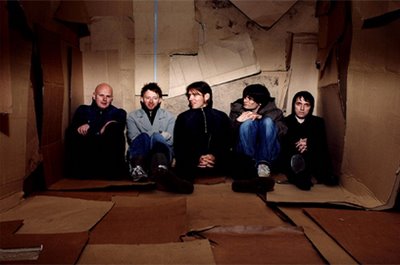
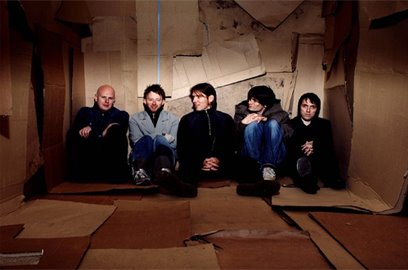
and also i just came across this photo of radiohead, and thought how nice it is to see thom york smiling (2nd from left)...
 and also to say that today my keyboard got tea spilt all over it and stopped working. so i've been using the on-screen keyboard that comes with windows. it is frustrating and takes ages to click each letter.
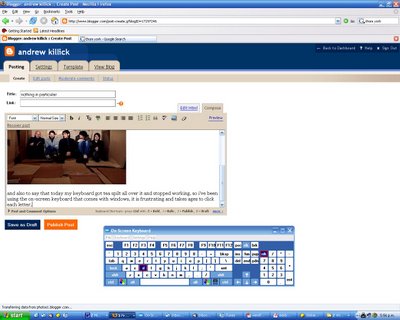 here is a picture of me writing this post - the keyboard is clearly visable near the bottom of the picture. (click on the image to see it bigger).
this post has taken me over 00:17:25 to write.
on the stereo... oh stuff it
this is not what i said i would talk about in my next philosophising post, but an idea came to me and you have to strike while the iron is hot... (if you want to catch up on what i've been raving about so far, the whole lot is here in pdf form)
one of the great mysteries about God is how the Trinity (Father, Son and Holy Spirit) functions as one. it occured to me that if we could could grasp the idea that in God's mind "physical" water (for example) and "spiritual" water are the same thing, the Trinity would not be so hard to envisage. it is made up of something concrete and something spiritual, but it is all same thing "conceptually".
but i came across something else interesting last night. in the study of semiotics (the way words and their meanings function) there are normally two parts to a "word" - the "sign" (ie the concrete word), and the meaning (ie the concept or object that the sign has been attached to). there are all sorts of other aspects in semiotics that look at how the sign becomes attached to the concept or object, but that's too much of a diversion to discuss here.
semiotics is normally based on "dyadic" thinking (ie involves thinking about two elements). but as we have seen earlier, ultimately God often prefers odd numbers, eg ones and threes.
walker percy (a christian novelist and thinker) proposed a third essential element to the study of semiotics. that is, the mind, or rather soul, in which the connection is made between sign and meaning. he called the inclusion of this third element "the delta factor" (because if you draw it on paper it looks like a triangle).
i'm actually not wanting to discuss semiotics here. i'm wanting to discuss a possible way of looking at the Trinity based on percy's semiotic model. whenever i see something profound that has three elements, i always try and superimpose it over the Trinity (Father, Son and Holy Spirit) to see if it reflects the relationship within the Trinity in any way and to see if it can help me understand the Trinity better.
in this case, percy's triadic structure seemed to have a rather interesting fit. supposing we lay his model over the Trinity. on one corner of his model we have the sign, on another corner the meaning (or "object"), and on the third corner, the element that connects the two.
the sign lines up rather neatly with Jesus, the son. Jesus is the concrete Word, the visible incarnation of God, so in that sense is rather like the sign - ie the visible word on the page.
the meaning (or "sense") lines up rather neatly with God the Father. he is the meaning of the Godhead (by Godhead, i mean the combined elements that make up God), the underlying "concept", the object, if you will, that "gives birth" to the word.
that leaves the third corner - that is, the thing that connects the two, and in our model that leaves the Holy Spirit. that would make the Holy Spirit a kind of glue that holds the Godhead together. robert inchausti in discussing percy's idea (in the book 'subversive orthodoxy') uses this phrase to discribe the third element: "a third 'player'... an invisible, immaterial 'coupler' that unites sign and sense". i have no idea whether percy or inchausti envisaged this similarity between percy's model and the Trinity - perhaps they did, in which case i'm getting excited about something that has already been thought of. but that description fits very nicely, i think, with a conception of the Holy Spirit.
the Holy Spirit is the element that holds Father and Son together. an element, interestingly, which Jesus gave to believers to unite them with God. percy also calls that third element in semiotics "the interpretor". which further bolsters the connection between the Trinity and his semiotic model, as Christian thought envisages the Holy Spirit as that which helps a person understand the mysteries of God.
now let's lay a third model over these two - the parts that make up a person (body, soul and spirit).
"body" overlays sign (word) and jesus (son), ie the concrete existence of the person. then i would say that "soul" overlays Father and meaning. the soul is that which makes us unique people - it is the concept and blueprint of who we are. "spirit" therefore overlays Holy Spirit. it holds body and soul together - it is the "lifeforce" (to use a word unfortunately laden with new age connotations) or the breath of God in us that gives us life - the connector between our parts. when the connector leaves, the body and soul are separated.
it is always exciting when you can overlay the parts of God to the parts of humankind, because it forms part of the meaning of God's phrase "let us make man in our own image". in a perfect, pre-fall state, a human would function internally (between their three parts) the way the Godhead does.
so, anyway, next time i plan to write about what i planned to write about last time: what it means creatively, here on earth now, to seek to work towards God's concept of unity given the nature of a world in division, and about the creative energy that exists in aiming towards this unity.
on the headphones: 'pepita' by calexico, from the album 'feast of wire'. www.casadecalexico.com
the art enigma banksy strikes again!
latest target is paris hilton's new album.
read more here, here, here, and banksy's website is here.
on the headphones: 'zoo station' by U2, from the album 'achtung baby'. www.u2.com
for some unknown reason, the blog's been offline for a few days - but now that we're back in business i can give you a bit of a rundown on the conference.
i had a great time, very cool being in that creative environment for a day. the event was sold-out and about 1200 people were there.
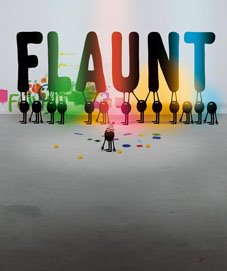 first up was genevieve gauckler from france. she has a very quirky style involving collage and recurring cartoon characters. her design process involves pain-stakingly cutting out photos in photoshop to compile on her works. needless to say, she takes loads of photos everywhere she goes. when she spoke she apologised from the start for not being able to speak english expertly, but she endeared herself to the audience. very cool stuff. here you see a cover that she did for 'flaunt' magazine. in this picture, the background is photographic with her trademark characters overlaid on top.
then it was tokyo plastic from uk. i won't bother trying to sum them up with an image. if you've never seen their website then head there now, by clicking on the link above. it was the website that launched the careers of the two man team. it is an incredible piece of flash animation - possibly the best on the internet. anyway, since then they have gone on to do a number of commercial projects, including ads for microsoft and animation work for guy ritchie. they are way out of my class and do things that i will probably never even attempt to do, but it was interesting to hear the story, and the guy who spoke was funny and well-prepared. some nice dry english humour in there.
after lunch, it was nz's own huffer. these guys have done an amazing job creating nz-designed and manufactured clothing. their stuff is often painfully cool. in fact anna and i were looking at their summer range today - very 80s, but people will lap it up no doubt. i've always been a fan and managed to score myself a rather nice huffer hoodie just the other day. as for the actual presentation at the conference, the two founders presented something which seemed to be pretty off the cuff - a style that didn't always come off. nevermind, they earn respect for doing what they've done with their company in nz. and it sounds like it would be a pretty cool place to work.
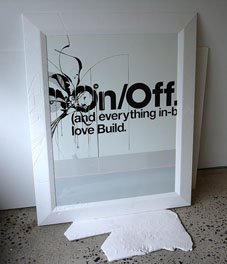 next up, michael c place. this guy was the highlight of the day for me. aesthetically i liked his style the best. he uses a lot of symbols and his work is very clean - almost like a medical label at times. he was terrified on stage but also very honest - the same tactic (if you can call it that, because it is natural) as michael leunig used the time i saw him speak. it comes from dragging creatives who are used to working alone out onto a stage in front of 1200 people in a two level auditorium. in the end he seemed reluctant to finish his slot and showed us heaps of work - all very good. have a look at his website to get an idea of his aesthetic.
after the afternoon tea break was abake. i really have no idea how to explain these guys - two french, one welsh and one japanese who live in london. they seemed (from what i could gather) to be as into performance art as design. one of their projects involves an old band rotunda in london somewhere - they are trying to restore it and hold regular community events there. their presentation was interesting as they all took turns standing in a spot light to tell us about various projects. at the end they took a video of everyone firing off their camera flashes in the darkness of the auditorium.
and then finally for the day, was taika waititi. he's the bloke responsible for the award-winning nz short film 'two cars one night'. he began his slot by showing us an incredibly funny low budget movie that involved him running around and shooting at things followed by a trademark smirk and thumbs up into the camera. his segment was like a one-man stand up comedy show and was really brilliant. including doing live drawings to illustrate his points on a wacom tablet attached to the big screen. he also showed us some of his drawings and paintings - showing that he really is an all-round creative guy. brilliant way to end the conference and keep us all awake as the day wore into early evening.
all good - i plan to be back next year.
on the headphones: 'who needs forever? (theivery corporation remix)' by astrud gilberto, from the album 'verve remixed'.
i'm reading a book at the moment called 'the worth of art: pricing the priceless' by judith benhamou-huet that discusses the various elements that effect the price that art is sold for.
i've come across a bit that talks how the myths surrounding an artist add to the price, and about how pieces of art are almost viewed like relics of saints.
a few months ago someone was selling the floorboards of one of colin mccahon's studios on trademe. i don't know if they sold or not, but it caused a bit of a fuss. mccahon's family saw it as bizarre. and perhaps rightly so. but i found myself thinking that i wouldn't mind having those floorboards in a room of my ideal house. why? i'm not really sure, but it is the same buzz you get by going to england and going to places that famous people lived and famous events occured. and for the same reason that jack kerouac's famed continuous roll of tyescript for 'on the road' is touring american libraries.
here are some choice morsels from 'the worth of art':
"In today's art market, an artist's work is interpreted through the prism of the myth associated with his life ... All that is asked of them is that they embody a myth. In this family of artists, figures whose 'art and life are one', Van Gogh is the absolute champion, in all catagories. Madness, the severed ear, unlucky in love, unsuccessful commercially - Vincent was no winner, and not even a moral example. But he did suffer, and that is a serious point in his favour. You can imagine the high priests of the artist cult having him replace Christ's words, 'for this is my body' with 'for this is my canvas'." [p93]
"The value of the painting is of course not just aesthetic; it is a relic, whose authenticity justifies the artist's suffering and by its presence allows us to share it." [quoted on p95]
"Ever since art was severed from its spiritual function (men have praised God through their art since time immemorial), it has been constantly in search of new justifications: beauty, sublimity, emotion, provocation, transgression. Why make art? In the end, for painters, getting rid of God as the ultimate source of inspiration led to 'art for art's sake'. But for many art lovers, and therefore buyers, art is not a sufficient reason for art. Enter the cult of money. To think in terms of 'art for money', or rather, 'art in exchange for money', is to give art a tangible criterion of value, a gold standard. It is a way of making art accessible to man, so that, for a while, man can pretend to be God." [and connect with the myth of the artist - his struggles and genius - through the one-off and original art work] [p103]
on the stereo: 'lay me down' by breaks co-op, from the album 'the sound inside'. www.breaksco-op.com
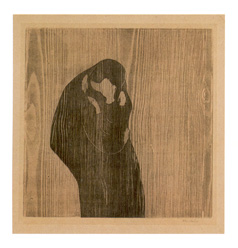 i've just finished reading a book associated with an exhibition that ran at the museum of modern art new york in association with the mori art museum tokyo in 2004 called 'modern means'. in recent times galleries have moved away from displaying art in terms of chronological art 'movements', and have begun grouping pieces from disparate periods along the lines of theme etc.
i think the thematic divisions that MoMA came up with to group modern art were quite interesting. here are the definitions that david elliot (director of mori) gives for their divisions (examples are loose, as some artists fit in more than one catagory):
primal: centres on the strategy of finding energy in the primitive forces of nature and the subconscious human mind. (eg. gaugin, munch, rodin, matisse, de koonig, gorky, pollock, bacon, freud)
reductive: traces the impulse to strip away inessential elements of form to uncover the 'purity' of what lies underneath. (eg. lloyd wright, picasso, mondrian, o'keeffe, kandinsky, albers, gego)
commonplace: considers ways in which art has absorbed mass culture and media, finding new forms of beauty in them and changing their nature in the process, sometimes with socially critical intent. (eg. christo, indiana, warhol, lichtenstein, rosenquist, hamilton, johns, koons, opie)
mutable: looks at the transforming power of art, its ability to make familiar things strange and endow them with new significance, sometimes with positive but more often with profoundly disturbing results. (eg. ernst, miro, man ray, gober, sherman, hurst)
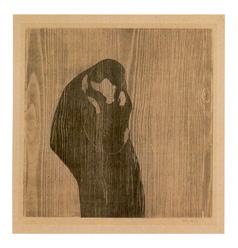
aesthetically, my favourite image in the book was the one above by edvard munch called 'the kiss IV' and dated 1897-1902. and not at all like 'the scream'.
on the headphones: 'following' by chungking, from the album 'we travel fast'. www.chungking.co.uk
as promised, here is the next installment of my ideas about breaking down dichotomy-based thinking. see below ('sun is shining') for part 1. today, by the way, the sun is most definitely not shining. in fact, we're having continuous rain.
in part 1, i talked about how dichotomy-based thinking could potentially be broken down by going back to a "hebraic" philospohical framework, and about how this could break down our traditional view of things like metaphor. but when you look around, and indeed when you look at christian thinking, you can see that there does seem to be evidence for a dichotomy. eg. light and darkness, sin and perfection - those sorts of things. so, i wanted to look at how the dichotomy came about, and what it can mean in reality.
when we look at things from a christian perspective, i think we can break ideas down into 'pre-fall' and 'post-fall' (there's a dichotomy for you). 'pre-fall' is a reality based on the conditions that existed in the world before sin entered it - God's ideal system. 'post-fall' is the stuff that became reality as a result of sin. it doesn't 'replace' the pre-fall system (that is the system that God works towards restoring), it is a system that came into effect as an ultimately temporary solution to deal with the realities of sin in the world.
one of the primary features of sin is that it divides. when it entered the world it created polarities. so, now instead of just having wellness, we also have sickness etc. it also drove a wedge between God and nature. because of this reality, the whole system has been forced into recognising dichotomies. even my differentiation of "pre-fall" and "post-fall" is a dichotomy that we are forced to create because of that reality. humans have helped to entrench those dichotomies by coming up with such ideas as "spirtual = good, physical = bad". in many ways this has been a coping strategy. it is evident that a lot of sin stuff happens in the physical, while it seems that if we could only think more "spiritual" then we could avoid a lot of sin. so hence the dichotomy emerges.
but, regardless of this coping strategy and the realities of the post-fall world, it is important to acknowledge that God has an agenda for unity. ultimately, his aim is to destroy sin and establish perfection forever, meaning that all dichotomies cease to operate. God's agenda is a kind of "higher logic", if you will (here another dichotomy i am forced to use), or as c.s. lewis might have put it, "a deep magic". a world in which "tangible" water and "abstract" water are one and the same entity is a world in which the logic of God is operating. we will probably never be able to experience the full extent of the collapse of metaphor in this regard in this current world. so we have the promise of a new heaven and new earth.
a feature of this new world, is the merging of "physical" and "spiritual". a demonstration of this is that christ's post-resurrection body was able to pass through locked doors but also able to be touched. it was both scarred and glorified. likewise, to go back to my favourite example, there will be no difference between "spiritual" water and "physical" water - there will be one entity eminating directly from God's primary concept of water.
the beautiful thing about this restored system is that the post-fall strategy will prove not to have merely been just a holding pattern while God sorted everyting out, but will be shown to have become an integral part of the main story. Christ's scars came about because of the post-fall strategy, but they nonetheless remain on him in the restored system - bearing witness for all time that God entered the post-fall system and has the marks to prove it.
i did have more to say, but i'll leave it for the next installment. next i'll talk about what it means creatively, here on earth now, to seek to work towards God's concept of unity given the nature of a world in division, and about the creative energy that exists in aiming towards this unity.
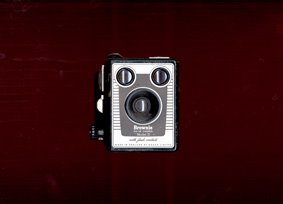
 the other night i experimented with putting stuff on the scanner. i found that if i left the lid up, i ended up with this nice wine colour in the background. scanning at 300 dpi picked up a lot of detail, including dust - but also the streaks left by the glass cleaner i'd used, which look a bit like wood grain. this is the picture i did of my box brownie camera. the picture still needs some cleaning, but otherwise this is the raw form of what the scanner gave me.
beautiful day today. anna and i went for a walk along the waterfront and i took my lomo with me. the tide was in, the water was perfectly calm, and no clouds in the sky. took some low shots of the sea and sky with a silhouette of the port providing a horizon line. so as long as i have been able to get my horizon level (one of my weaknesses) and have avoided lens flare shooting into the sun, they should be nice shots.
anyway, i've been reading g.k. chesterton's book 'orthodoxy'. i'm particularly enamored with his idea that christianity is a belief system that allows two seemingly opposite ideas to be held true with equal and undiminished strength ("the paradoxes of christianity"). one of his examples is that orthodox christianity treats suicide as a sin and matrydom as a virtue. it doesn't mean that if you are a christian you can believe whatever you like (there is an established orthodoxy) but it seems to me that chesterton's angle on christian orthodoxy gives it strength in a postmodern pluralistic world. i could go on for hours about this.
in postmodernism there is an idea that no "truth" precludes any other "truth". because of the difficulty of this position in practical everyday terms, society has come up with the idea that you have to do what is right for you. obviously that's not a position that a christian can hold (because we believe that God has established clear standards), but in the last few years i've come to think that perhaps the simple christian view that things as are basically a dichotomy is actually simplistic. rather than being a "christian" point of view, i now see that approach as being more of a grecio-roman point of view. ie, it was constructed through the heavy influence of greek thinking and logic in the western world. i seem to recall that this process was helped along by aquinas in the middle ages (i think, from memory, it had something to do with plato).
[this is getting way too long for a blog post.] the first thing that lead me in this direction, away from a purely dichotomistic view, was looking at the way logic functions in the old testament, hebrew, worldview. i don't think God really uses metaphors - not in the way we tend to think of them anyway.
we see a metaphor as being a thing that stands for a another "higher" meaning. so when the bible talks about "water" (for example) we like to divide those instances up in "actual" water and "metaphorical" water. but i'm not sure that that is the way God sees it. i think God sees water as conceptually the same whether it applies to spiritual or physical matters (maybe there is ultimately no division between spiritual and physical - but i'll use those terms for now, otherwise our minds might blow up). i think that in God's framework, what we consider to be material water and metaphorical water are in fact exactly the same thing conceptually. so whether "water" is material or "abstract" it always functions in the same way: it provides life, healing, sustainance and cleansing - it doesn't matter how it is embodied.
the same thing holds true for the bible's description of christ loving the church like a bride, and the bible's command that husbands should love their wives like christ loves the church. i think we tend to build a hierarchy into that truth. we see earthly marriage as a metaphor for something more spiritual, thereby implying a hierarchy between what God has us doing on earth as opposed to his own activities. i don't think such a hierarchy exists. instead i believe that christ loving the church and husbands loving their wives is in fact conceptually identical. that comes about because the same God had the same concept for both humans marrying and christ uniting with his church.
here's a practical application of what i mean: over the centuries, commentators have interpreted song of solomon (or 'song of songs') as being a giant metaphor about christ's love for his church. that interpretation avoided the embarassment of all the "racey" potential of some of those passages if they are in fact about human erotic love. in recent times, commentators have said, "come on, this is obviously a celebration of human sexuality." but if you move song of solomon into the framework i am proposing, it is in fact BOTH of those things equally and indivisably - not one or the other. conceptually, both those things are the same thing. that fact has come about because the designer or author (God) has applied the same concept to both human sexuality and the intimacy between God and his church.
this is a work in progress, so i'm yet to fit all the pieces together in my own mind, much less try and communicate them in writing. but i think there is some way in which chesterton's idea fits in with what i'm saying. and that all this serves to show that christianity is as relevant today (in the postmodern world) as ever. i think it cuts to the heart of the postmodern desire to get away from dichotomy. and so, rather than try and communicate that, i'll just cut and paste the pertinent passage from 'orthodoxy':
"...sometimes this pure gentleness and this pure fierceness met and justified their juncture; the paradox of all the prophets was fulfilled, and ... the lion lay down with the lamb. But remember that this text is too lightly interpreted. It is constantly assured, especially in our Tolstoyan tendencies, that when the lion lies down with the lamb the lion becomes lamb-like. But that is brutal annexation and imperialism on the part of the lamb. That is simply the lamb absorbing the lion instead of the lion eating the lamb. The real problem is - Can the lion lie down with the lamb and still retain his royal ferocity? THAT is the problem the Church attempted; THAT is the miracle she achieved."
i might write a part two on this. in part two, i might argue that the establishment of a dichotamistic view has been a survival strategy in a world where ultimately "physical" and "spiritual" cannot be united perfectly because of sin. and that the final consummation of those two seemingly opposed elements will not happen until there is a new heaven and earth. that might be interesting.
a long awaited upgrade has just occurred on www.andrewkillick.com
there is now a third page to the gallery, featuring some of my more recent work - click on the photo in my hands on the home page to access the gallery, and then click 'page 3'...
also, you can now buy an eBook version of my poetry book 'epilogue' (given that there are virtually no paper book copies left). that costs US$4 on paypal, and you get to that bit on the website by clicking on the cover of the book on the home page of the website.
sweet.
i'm currently in the process of reading an excellent book called 'the christian imagination' edited by leland ryken (sounds a bit boring i know - but truly isn't). i'm always on the look-out for quotes etc that help define what i mean by my 'safe little world' concept and how that can be realised through art.
in an essay by gene edward veith jr called 'reading and writing worldviews' included in 'the christian imagination', i found this quote:
"The very act of writing involves the articulation of meanings - drawn from the author's beliefs, assumptions, and imaginative constructions - that constitute a little world, which readers, by letting the language play in their own minds as they read, can access in their own terms."
on the headphones: 'we r the omc' by omc, from the album 'in the neighbourhood' (various).
well now, i had a great response to the music question. this was the question: "if you had to choose the musical works of just one artist/band/composer and forego all others, who would it be?"
and now for the results...
1st=: Bach, the Beatles, and U2.
2nd: Miles Davis
the really interesting part is that other than those four artists/bands/composers no other nomination received more than one vote. the other nominations (in no particular order) were:
pink floyd
massive attack
linkin park
mike post
steven curtis chapman
the vineyard worship team
king david
crowded house
sarah mcloughlin
tom waits
bob marley
third eye blind
tangerine dream
radiohead
colm
vivaldi
bob dylan
don mcglashan
bic runga
it has to be pointed out that some people cheated a little bit and said more than one (i've included those as well). but in general, answers were pretty clear.
what i plan to do now is a weekly article on each of the nominated artists - so stay posted. feel free to leave comments below.
on the headphones: 'let's talk' by coldplay, from the album 'x & y'. www.coldplay.com
i read a couple of the print editions of the artisan journal this week. very cool. artisan is christian arts/media organisation in the uk with networking into ny and la.
having been impressed with how cool their journal is (read the copies cover to cover) i visited their website which turns out to be a great resource.
anyway, as an offshoot of that, i found this quote in an article on their website by makoto fujimura, artist and founder of IAM:
"In art we create and imagine our belongingness. We are, in this sense, creating a home for our imaginations to inhabit. What kind of a home is it? Is it inviting? Is it haunted? Is it a loft in a city or a farmhouse? Or is it a home far away, a home that we can only long for?"
i love this quote, and think it is spot-on for me and my 'safe little world' concept, which celebrates the safety of an imaginery/real world, (sub)urban homes (or homes set up against the wilderness) but also questions the safety of it. so there we are.
on the headphones: 'j connais mon role' by mc solaar, from the album 'mach 6'. www.solaarsystem.net
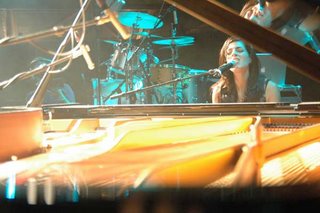 i went to the noise conference last weekend. 1500 christian musos got together for two days of teaching, music and electives. while i'm not primarily a muso, i get a creative buzz out of going to the conference (this was my second time) and my official excuse is that i play hand percussion and do some bv's for church music.
noise featured a few quite big names in christian music. nz's own brooke fraser (pictured - not a photo i took, by the way), phil joel of the newsboys, hillsong united from australia, and speaker phil baker amongst a lot of others. in the event, all these people i've just listed were highlights - brooke fraser for her sheer talent combined with genuine commitment to God, phil joel for being a down-to-earth and onto it talented new zealander, hillsong united for delivering the most full-on praise and worship music ever, and phil baker for being an incredibly good speaker, with clear insights and brilliant humour.
once again the noise conference delivered, and i'll almost certainly be there next year. i had a little run-in with the gravel carpark outside the venue (sprinting + gravel = sore knee + torn jeans) but nevermind - maybe i got a little over excited.
you can see parachute music's official photos of the event (including the one above) here.
on the headphones: 'no roots' by faithless, from the album 'no roots'. www.faithless.co.uk
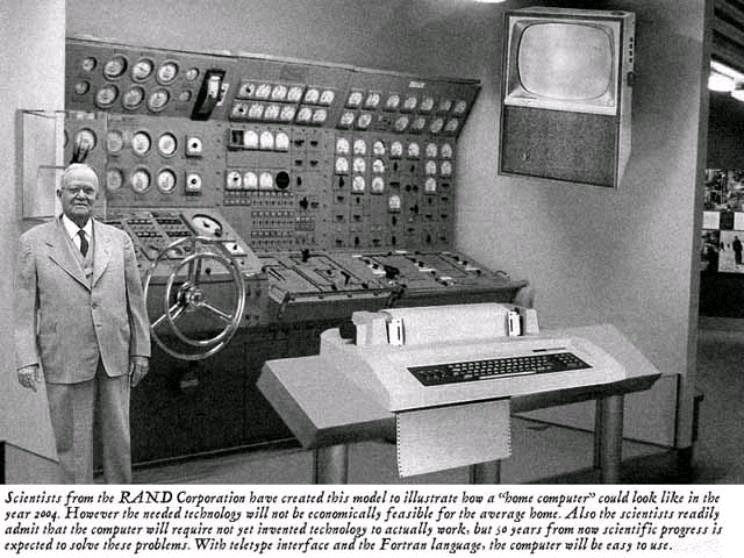
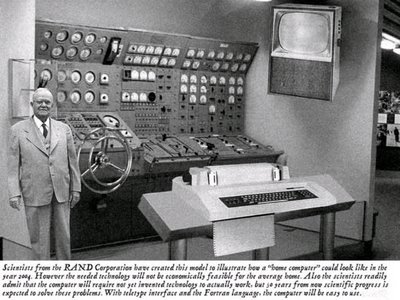 i got this picture by email today. what incredible foresight these scientists showed in 1954. it looks exactly like the computer i had in 2004 (see caption, click the image to see it full-size)...
on the headphones: 'the sicilian' by bonobo, from the album 'one offs ... remixes and b-sides'. www.bonobomusic.com
hello. after another hiatus in posting, i have again accumulated probably more info than you'd normally squeeze into one post.
pt 1: we've just had the easter jazz festival here in tauranga. my father came down and we caught a couple of great concerts. firstly, the nathan haines show, and then a tribute to miles davis with some of the best jazz musicians in nz. some brilliant virtuoso playing all round.
pt 2: my mate malcolm dunn is working on an ep under name 'colm', and you can check out the post-rock niceness at his myspace site.
pt 3: i've completed my art project - a6 cards of my work, printed and cropped and then arranged into a montage with fotoclips that now hangs in our lounge. the cards are starting to curl and i don't suppose that will stop - i really needed to add more clips, but for now i am telling myself that the slight curling is part of the appeal of the medium. i've taken a somewhat nasty picture of the montage with my cheapo digital camera and you can see it by clicking here.
pt 4: don't forget that if you're so inclined you can subscribe to this blog over there on the righthand column, and get newsfeeds as i post new stuff.
pt 5: i'll be putting two new book reviews and maybe a film review on intraspace very soon.
pt 6: the film 'noi the albino' is great.
pt 7: next week i'm off to the noise conference in auckland. last year this was brilliant - a two-day conference for musicians with a little thrown in for creatives in general. inspirational and exciting, it's the main thing i've been looking forward to so far this year. stand by for a report on that in a couple of weeks.
on the headphones: 'could you be loved?' by bob marley, from the album 'legend'.
another long delay between posts. so what's new?
well, for a start you can now subscribe to a news feed from this blog - meaning that whenever i update you will get the new content sent to you. you can subscribe to this (free) by clicking here or on the link to the right. i also have a subscription service for my reviews blog, intraspace. subscribe to that one here or by visiting intraspace.
speaking of intraspace, there is a new review on there - a review of the book 'bono on bono'. well worth checking out.
in my creative world, i am working on a project to help me better visualise my aesthetic approach, and to see some of my artwork functioning away from the computer screen (ie on the wall). at the moment i am using quite a few different visual styles. there is a common thread in that they tend towards 'pop art' but in some cases they are in very different areas stylisitically. so, i'm in the process of turning some of the pieces (including some of my photography) into A6 pictures (partly also in preparation for my postcard project) printed on card. once i have a few of these printed out, i'm going to crop them and then put them together with photo clips to create a montage which will then hang on our lounge wall. i've always seen my visual work in terms of groups of images displayed close together, so apart from this being a learning experience it will also help me realise that aim. the process has already helped to stimulate my creativity and last weekend i made four brandnew pieces as well as polishing some existing ones. the finished montage will evolve and grow as i create and print out new pieces. i'll post a pic of the montage when it is ready to go.
in other news, rob and i went to the bic runga concert at tauranga's holy trinity church. the whole thing was brilliant. she played a lot of her new material which is very atmospheric. her band included neil finn, shayne carter (dimmer) and anika moa plus the guitarist from pluto (tim arnold). they were supported by flight of the concordes, a brilliantly funny musical duo (sold out concerts at the edinburgh fringe festival etc). i don't normally go in for joke music but these guys are great. if you get the chance to see bic or flight of the concordes then get to it.
on the headphones: 'lsd partie' by roland vincent, from the 'ocean's twelve' soundtrack.
 and also to say that today my keyboard got tea spilt all over it and stopped working. so i've been using the on-screen keyboard that comes with windows. it is frustrating and takes ages to click each letter.
 here is a picture of me writing this post - the keyboard is clearly visable near the bottom of the picture. (click on the image to see it bigger).